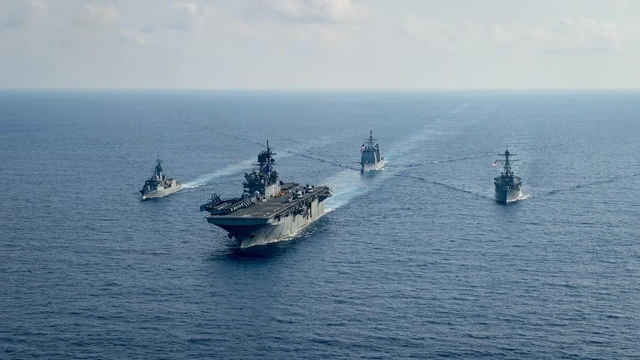
Washington [US], December 16: U.S. officials reject the notion that Washington is withdrawing from the Indo-Pacific region, asserting that Washington is merely readjusting how it deploys foreign aid to more effectively compete with China.
According to the South China Morning Post on December 16, citing US officials, the current focus is shifting from broad aid to strategic partnerships that serve Washington's long-term interests, ranging from developing essential infrastructure, maritime security, and critical minerals to military funding, in order to strengthen the region's resilience and counter the influence of hostile forces.
U.S. Under Secretary of State for Political Affairs Allison Hooker emphasized that this is a "strategic adjustment, not a retreat." She stressed that Washington's commitment to the region remains "unwavering."
The official said the new approach reflects the 2025 U.S. National Security Strategy ( NSS ), which identifies the Indo-Pacific as a key economic and geopolitical front and emphasizes the role of alliances and partnerships.
However, some critics argue that this strategy risks diminishing the role of the United States. A report by the Korea Economic Institute in the US argues that the NSS 2025 is a "retreat" strategy that "leaves Asia to fend for itself," suggesting that Washington is asking its allies to shoulder the majority of regional security responsibilities.
Taking the Philippines as an example, Ms. Hooker emphasized that the U.S. continues to support private sector development within the Luzon Economic Corridor - a trilateral initiative between the U.S., Japan, and the Philippines launched in 2024 under the G7's Global Infrastructure and Investment Partnership.
This initiative focuses on connecting strategic hubs such as Subic Bay, Clark, Manila, and Batangas through investments in railways, seaports, clean energy, and semiconductors, aiming to foster transparent, privately-led growth.
"The Philippines continues to face serious challenges in the South China Sea ," according to Ms. Hooker. She affirmed that these support efforts demonstrate the U.S. commitment to maritime security , freedom of navigation, and collective defense in the region.
Speaking at the first Indo-Pacific Regional Diplomatic Support Conference, Ms. Hooker affirmed: "The United States is a Pacific power, and the future of the Indo-Pacific region is directly linked to our core national interests."
She stated that foreign aid is increasingly seen as a "lever of human resources and power," aimed at delivering sustainable security benefits rather than merely addressing short-term needs.
On December 15, U.S. Under Secretary of State for Foreign Aid Jeremy Lewin emphasized that U.S. aid is being reshaped as a tool to promote economic partnerships and achieve strategic goals. He said the U.S. will increase spending in the Indo-Pacific region, including expanding medical aid to the Philippines by $250 million and increasing military funding for allies.
Concerns about the U.S. cutting foreign aid stem from the "America First" policy, in which the Trump administration comprehensively reviewed overseas spending and proposed budget cuts for the State Department and USAID , including a plan to cut $5 billion in aid already approved by Congress.
Nevertheless, US officials insist that Washington is not abandoning foreign aid but is "fundamentally restructuring" its deployment methods to maintain US soft power and strategic influence throughout the Indo-Pacific region.
Source: Thanh Nien Newspaper